


A booth that reads the sky you were born under against the sky of right now.
Oráculo / Oracle Booth · Ygor Marotta (microdosys) · 2026
Bombay Beach Biennale, California, March 2026 · Festival Veludo, Heliodora, September 2026
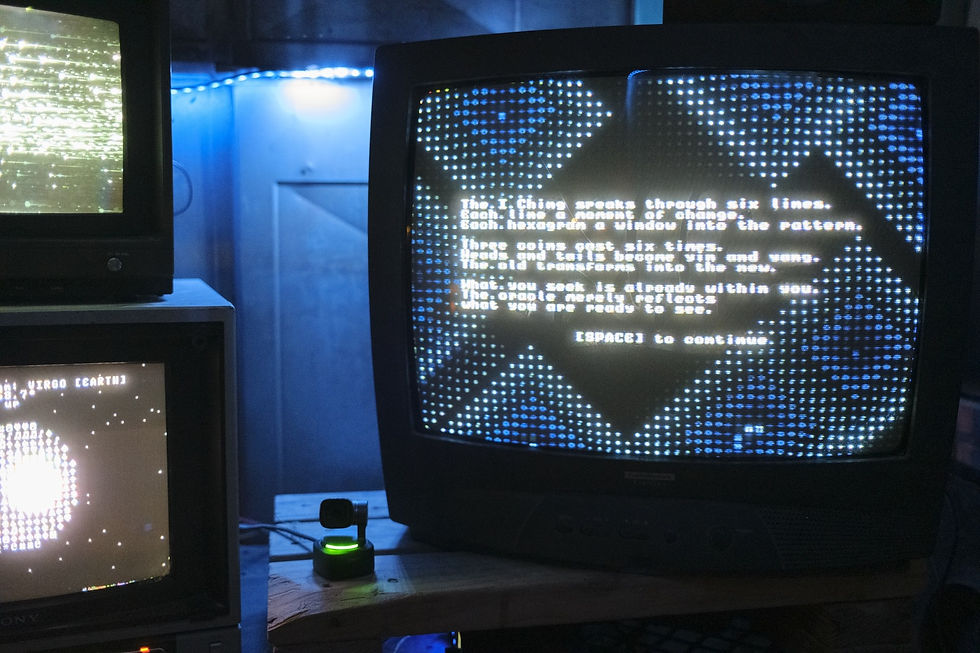
The Oracle is an interactive, synesthetic experience, written in code by the artist, that takes place inside a booth. Whoever steps in types the date, time and place they were born, and that data meets the sky of that very moment, calculated live. From the meeting of the two skies come, in real time, synthesized music, concrete poetry and light. On the CRT TVs, everything is a character: the sky, the poems and even the body of whoever is sitting there turn into letters. Midway through, a question to the I Ching; at the end, the whole reading printed on a strip of thermal paper.
Astrology, I Ching, sound synthesis and computational poetry meet there as languages of a single act of listening. The booth works as a listening space: whoever is inside hears their own chart become music, whoever waits outside listens too, and one person’s reading opens a shared space around it. The Oracle’s subject is the present: its shape, its pressure, its texture.
The sky keeps moving. Half an hour later, the reading would be different.


how the sky becomes sound, image and word
The booth runs on software the artist wrote from scratch over more than a year, and everything in it starts with astrology.
the birth chart and the sky of right now
With your date, time and place of birth, the Oracle calculates the birth chart of whoever steps in. At the same time it calculates the sky of right now: the position of every planet in the solar system above the booth, updated every minute. The reading comes from the meeting of the two skies and the angles the planets form with each other, the aspects, which tell whether the moment is tense or in harmony.
music
The music comes from those positions. The sky picks the key, the mode and the tempo, and each aspect becomes an interval: a conjunction sounds in unison, a square becomes a tritone, a trine a fifth. From there come the chords, arpeggios and harp phrases, played by voices that carry each planet’s name and character: the Sun is bright, Saturn is cold, Neptune is hazy, Pluto is dark. Nothing is prerecorded: the same sky always sounds the same, but since the sky never stops moving, the music never repeats.
image
Everything on the screens is made of characters. The camera redraws the body of whoever is inside in ASCII, and each letter of the poem types itself with its own tone. The colors come from the sky too: the Moon’s element opens the session, and then the chart, the sky of right now and the hexagram choose the palette, the glyphs and the effects. The light on the structure follows the same data.
word
Western astrology and the I Ching read the moment. A language model writes the poems live from the chart, the transits and the hexagram, held to the voice of the work: present tense, concrete images, no predictions. The poems come out in Portuguese or English: the language follows where the booth stands and where the visitor was born.
the booth
A small space, for one person at a time. Inside: three CRT TVs, a keyboard, a camera, two studio monitors, a subwoofer, a thermal printer and a line of LED light running along the structure.
On the CRT screens, everything is typography: glyphs that light up, scramble and rearrange themselves on stage, in time with the sound.
A single computer calculates the sky and runs the sound, image, light and printing. The sky is calculated on the machine itself, and a local model keeps the poems coming even without internet.


layers of perception
Layers of Perception is the Oracle’s visual engine. Nothing in it is an image: every point on the screen is a character in a monospaced grid, with a color and a glyph. Stars are dots, fire rises in blocks, the body of whoever is in the booth shows up in ASCII through the camera, and the poems type themselves over all of it. Pattern and poetry share the same material.
patterns
Thirty generative algorithms fill the grid with animated characters: starry skies, elemental forces, analog waves, sacred geometry, cellular automata. Six more belong to scenes of their own, such as the I Ching, Dreamtime, Zeitgeist and the phases of the Moon.
effects
Eighteen post-processing effects, such as bloom, aura, VHS, fire trails and circuit bend, transform the grid like analog video, only made of characters. The same colors leave the screen and travel to the LED strips around the booth.
synthtext
The text engine treats words as an instrument: every letter has a sound, every poem has a body. Text can type itself out, scramble, glitch like a bad signal or appear through one of 28 terminal effects: burn like fire, fall like rain, rise from a lake, assemble itself like code.


the first booth, in Bombay Beach
The first version was born during a three-month residency at Mars College, an off-grid community in the California desert. It was built in a solarpunk spirit from salvaged industrial scrap: refrigeration panels for walls, reclaimed wood for the frame and, as the entrance, the door of a washing machine studded with broken mirrors. AJ Tarnas collaborated on building the physical booth, and Zayne Amason on developing the LEDs.


It premiered at the Bombay Beach Biennale, on the shore of the Salton Sea, in March 2026: four days, more than a hundred visitors, each one alone in the booth. By the end of the four days, the booth had become two things at once: a personal oracle for each visitor and an instrument tuned to that stretch of desert.
It’s still there. Today the first booth lives on the corner of 3rd and F, in Bombay Beach.
the second booth, in Heliodora
Its first showing in Brazil was at Festival Veludo, in Heliodora, in the mountains of southern Minas Gerais, from September 4 to 7, 2026, in a new booth built with the same thinking as the desert one: the metal pieces of the walls, the aluminum and the letter O came from recycling centers, and the deck and rain cover were made of bamboo. The frame is steel, 2.00 × 1.20 m at the base and 2.24 m tall, wrapped in mesh and fabric, with a seat for one or two people. In Brazil, the LED circuit board (PCB) was developed together with Junior Machado.
It opened at 5 pm and ran until nearly 2 am, and the line never emptied: the chair was occupied 81% of every open hour. Each night drew more people than the last (21, 30, 42 and 44 readings), while the Moon waned from 41% to 11% light.
137 readings for 133 people over four nights: 809 poems and 86 meters of paper.
The most common question asked for direction: 30 of the 104 questions typed wanted to know which way to go, or whether to stay. Two strangers, thirteen minutes apart, typed the very same words: "what is my purpose in life". Some typed nothing at all and let the coins fall in silence.
The booth keeps a record of every reading. These numbers come from it.
the Oracle, illustrated in typography


behind the booth
The Oracle is the first physical form of Synæsthetic Syntax, the computational-poetic research the artist develops as microdosys.

MULTIVERSO, the sound panel
sound
Six instruments written for the booth play the sky at once, and an orchestrating brain, Sound Control, reads the sky of right now and decides who comes in, who drops out and when the music swells or falls. Oracle of Chords is the chord voice, with eighteen planetary timbres and three ways of playing: fingerpicked, harp and arpeggio. PULSE 555 is the rhythm, a generative drum machine of kick, clicks, noise, FM and bass, whose sequences are born from the sky and respond to the planets crossing the horizon. VOID is the drone, with three voices, shruti, breath and ohm, anchored to the key of the day. Planets Resonator is the slow chord of the planets, each with its own note and register. ORBIT is a melodic sequencer that weaves phrases from the aspects. LASCA is an instrument of synthetic musique concrète, with sound objects written in code, not recorded through a microphone.
Alongside them, OMNI, an Omnichord, is played by hand, and SAM gives the booth the voice of a 1982 speech synthesizer, the Software Automatic Mouth. On the mixer, two effects: AETHER, the room, a shared reverb, and the Tape Delay, a virtual tape where each repeat comes back darker and more worn. Everything runs in the browser, in real time.
loom
Where the poems are made: a library of more than 370 concrete poems, each with its own animation, palette, glyphs and sound. The artist writes and edits there, keeps the poems written for each place and runs the live generation.
synæsthetic syntax
A computational-poetic system that translates astronomical data into sound, image and concrete poetry.


dreamtime
When no one is in the booth, the Oracle doesn’t stop. It slips into Dreamtime, its resting mode, and starts reading the moment instead of a person: the sky of right now, the phase of the Moon, the hour, the weather and the place where the booth stands. What comes out is computational poetry projected on the walls, where the position of each letter on the screen weighs as much as the word.
Each place enters the system as context. For every city, the artist writes an environment: what can be seen, what can be heard, what the land produces, a vocabulary of concrete words and the colors of the place. Some poems are written live by a language model from that environment and the sky of that hour; others are composed by rules written in code, which build the ASCII out of the place’s own words.
In Bombay Beach, the vocabulary was salt, dust, heat, the dry playa, abandoned trailers, the train whistle on the tracks at dusk, the shore of the Salton Sea receding a little more each year, and a dark desert sky where the stars become architecture. In Heliodora, the booth stood outdoors, under a tree, beside the Cachoeira do Pedrão waterfall, and the words became water, stone, forest, mountain, evening damp, morning dew, fireflies, the waning moon of each night and the coffee picked by hand in the Mantiqueira mountains, only the ripe fruit, one by one.
Words become image. In one poem, the phrase "the water doesn’t stop" steps down the screen like the falling water; in another, the harvest is a field of light blocks where only a few are full; in another, the shore pulls away line by line. The palette, the glyphs and the background pattern also change with the place: forest, moss and water in Minas, sand and terracotta in the desert.
After a reading, Dreamtime holds on to the last I Ching hexagram and keeps writing in that voice until the next person sits down. A projector carries all of this outside: the walls become a screen, and those waiting in line get a second reading, the one of the sky over the place.


a pause in the middle of the night
The booth is a space of presence. Inside there is nothing to get right and nothing to guess: there is the sky of right now, a question and a few minutes of silence around it. Whoever steps in ends up listening to themselves, in the music born from their own chart, in the words slowly typing across the screen, in the body that reappears made of letters.
That listening doesn’t stay inside. Out front, people in line read the poems Dreamtime projects on the walls, hear the sound leaking from the booth, talk to whoever just walked out holding a still-warm strip of paper. Each person resonates with the system in their own way: for one it’s music, for another a mirror, for another a conversation with the sky. The same sky never meets two people the same way.
In the middle of a festival, the Oracle opens a pause. One person at a time, time slows down, and the whole night leaves behind a trail of paper and poems that no one else will ever read the same way.
The booth travels. To host it, write to ygormarotta@gmail.com: setup time and technical needs follow by email.
concept and software: Ygor Marotta (microdosys) · first booth built in collaboration with AJ Tarnas · LEDs: Zayne Amason (Bombay Beach) and Junior Machado (Heliodora) · photos: Ygor Marotta, Laura Austin, Renata Chebel and Gandala